
Knot Tying Guide
Knowing the right knot makes camping, sailing, fishing, climbing and moving house easier and safer. Choose what you need to do — make a loop, tie to a post, join two ropes, tension a line — and the guide suggests suitable knots with clear step-by-step instructions, common mistakes and when not to use them. Tick knots off as you learn them and print pocket cards.
- Free to use
- No sign-up
- Runs in your browser

Knot finder
Knot Cards Pack
Printable knot cards for ten essential knots, a knot practice tracker, a rope care checklist and a camping and boating quick-reference sheet.
- Knot cards (PDF)
- Practice tracker (PDF, DOCX)
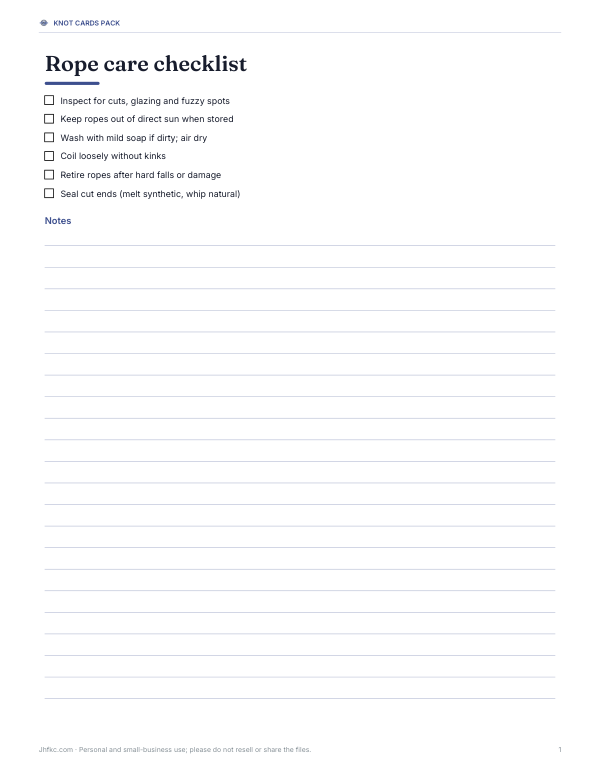
- Rope care (PDF, DOCX)
- Quick reference (PDF)
Formats: PDF, DOCX. Instant download after payment (link valid 72 hours, up to 5 downloads). AI-assisted: the templates were drafted with AI help and reviewed and laid out before publishing.
$3.00 USD, one-time 4 files · about $0.75 each
- Instant download
- 7-day refund
- Secure checkout by Stripe
7-day money-back guarantee. Full refund within 7 days of purchase, even after you download.
Free sample: Knot Cards (PDF, 62 KB)
Full refund within 7 days — see the refund policy and license.
Free printables
Single sheets you can print right now, no sign-up. The full pack adds every sheet in one download plus the editable files.
 Printable Knot Reference Chart
Ten essential knots
| Knot | What it does | Typical uses |
|---|---|---|
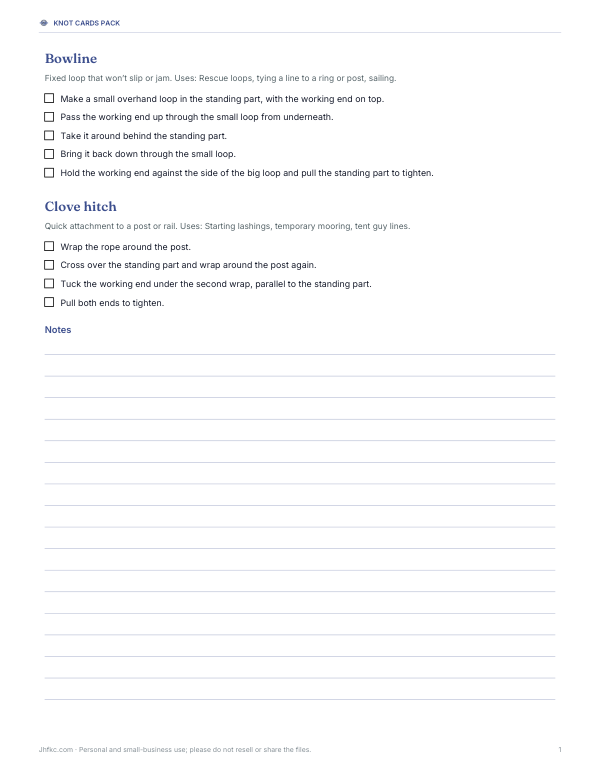
| Bowline | Fixed loop that won’t slip or jam | Rescue loops, tying a line to a ring or post, sailing |
| Clove hitch | Quick attachment to a post or rail | Starting lashings, temporary mooring, tent guy lines |
| Figure-eight stopper | Stops a rope running out through a hole or device | End of a sheet or halyard, climbing ropes |
| Reef (square) knot | Joins two ends of the same line around an object | Tying bundles, bandages, reefing sails |
| Sheet bend | Joins two ropes, even of different thickness | Extending a line, attaching to a net or sail |
| Two half hitches | Secures a line to a post or ring | Mooring, hanging loads, finishing other knots |
| Taut-line hitch | Adjustable loop that holds under tension | Tent guy lines, tarps |
| Trucker’s hitch | Tightens a line with mechanical advantage | Securing loads to a roof rack or trailer |
| Improved clinch knot | Ties fishing line to a hook, lure or swivel | Monofilament fishing line |
| Double fisherman’s | Securely joins two ropes | Making prusik loops, joining climbing cord |
Knot vocabulary
| Term | Meaning |
|---|---|
| Working end | The end of the rope you tie with |
| Standing part | The rest of the rope, usually under load |
| Bight | A U-shaped bend in the rope that doesn’t cross itself |
| Loop | A bend where the rope crosses itself |
| Hitch | A knot that ties a rope to an object |
| Bend | A knot that joins two ropes |
| Dress | Arrange the knot neatly before tightening |
How to learn knots quickly
- Practise with a short, soft rope about a metre long and a thick marker as a “post”.
- Learn one knot at a time until you can tie it with your eyes closed.
- Dress each knot — remove twists — before pulling it tight.
- Test it: load the standing part and check it holds as expected.
- Practise untying too; good knots are easy to untie after loading.
- Revisit knots weekly; they fade quickly if not used.
Choosing the right knot
Match the knot to the job. A bowline makes a loop that won’t slip but can loosen when not under load, so back it up for critical uses. A clove hitch is fast but can slip on smooth poles or with changing loads. The reef knot is only for binding around something — never for joining two ropes that will be pulled, because it can capsize and come undone; use a sheet bend or double fisherman’s instead. For fishing line, use knots designed for monofilament or braid.
Worked example
Tying down a tarp over a load on a trailer: tie one end to the trailer rail with two half hitches, run the rope over the load, and at the other side use a trucker’s hitch around the rail to pull the rope tight with extra leverage, finishing with two half hitches. For the tent guy lines at camp, a taut-line hitch lets you adjust tension as the canvas stretches.
Safety note
For climbing, rescue, lifting people or heavy loads overhead, get training from a qualified instructor and use the knots, equipment and backups your activity requires. Any knot weakens a rope — often by a third or more — and ropes wear with age, sunlight and abrasion. Inspect ropes regularly and retire damaged ones.
Knots by activity
| Activity | Most useful knots |
|---|---|
| Camping | Taut-line hitch, clove hitch, bowline, two half hitches |
| Sailing and boating | Bowline, cleat hitch, clove hitch, figure-eight, sheet bend |
| Fishing | Improved clinch, palomar, surgeon’s loop |
| Moving and roof racks | Trucker’s hitch, two half hitches |
| Climbing (with training) | Figure-eight follow-through, double fisherman’s, prusik |
| Scouting and everyday | Reef knot, sheet bend, bowline, round turn and two half hitches |
Common knot mistakes
- Leaving the tail too short — leave at least ten rope diameters.
- Not dressing the knot, so crossed strands weaken it.
- Tying a granny knot instead of a reef knot (left over right twice).
- Using a slippery rope with a knot designed for rough natural fibre.
- Forgetting to check a knot after it has been loaded and unloaded.
Rope types
- Nylon: strong and stretchy, good for anchoring and shock loads.
- Polyester: low stretch, UV resistant, common for sailing lines.
- Polypropylene: floats, cheap, but weakens in sunlight.
- Natural fibre (cotton, manila, sisal): good grip for knots, but rots if stored wet.
- Paracord: light nylon cord, handy for camping but not for climbing.
Using the knot finder
- Choose what you need to do, or show all knots.
- Follow the numbered steps for each suggested knot.
- Tick “learned” once you can tie it confidently; progress is saved in this browser.
- Print knot cards for your pack, boat or tackle box.
What the printable pack includes
Pocket knot cards for all ten knots, a knot practice tracker, a rope care checklist and a camping and boating knot quick-reference sheet.
Frequently asked questions
What is the most useful knot to learn?
The bowline, closely followed by the clove hitch and the figure-eight stopper.
What knot joins two ropes of different thickness?
The sheet bend.
Is the reef knot safe for joining ropes?
No — use it only to tie around something; use a sheet bend or double fisherman’s to join ropes.
What knot adjusts tension on a tent line?
The taut-line hitch.
What is the best knot for fishing hooks?
The improved clinch knot is a popular choice for monofilament.
Is my progress saved?
Yes, in this browser only.
How do I stop a knot slipping on slippery rope?
Use knots with more turns, such as the round turn and two half hitches, and leave long tails.